A Kansas City garage floor coating costs $3,000 to $7,000. Done right, it lasts 15 to 20 years. Done wrong, it peels in a year — and you pay again to grind it off.
Why These Questions Matter
A garage floor coating isn’t paint. It’s a chemical-bonded system that has to survive freeze-thaw, road salt, hot tires, and 4,000-pound vehicles. Most failures don’t come from bad products — they come from contractors cutting corners on prep, skipping moisture tests, or selling cheap warranties they’ll never honor. The seven questions below catch all of that, before you sign a contract.
Question 1: “Are You Licensed in Johnson County or Kansas City, Missouri? Can I See Proof?”
This is the fastest filter. Contractors working in Kansas City, MO and Johnson County, KS are typically required to carry a contractor license, general liability insurance, and workers comp if they have employees.
- Kansas City, MO requires a city contractor license, a Prometric or ICC exam, and $1 million in general liability insurance.
- Johnson County, KS issues 11 license classes and requires general liability and proof of good standing.
A real coating company has no issue showing a license and insurance proof. A shady one gets defensive, changes the subject, or says “we don’t need one.”
If a worker gets hurt grinding your slab and the contractor doesn’t carry workers comp, you may end up exposed — homeowners insurance often won’t cover injuries to people doing paid work on your property.
Question 2: “Do You Grind With a Diamond Grinder or Do You Acid-Etch?”
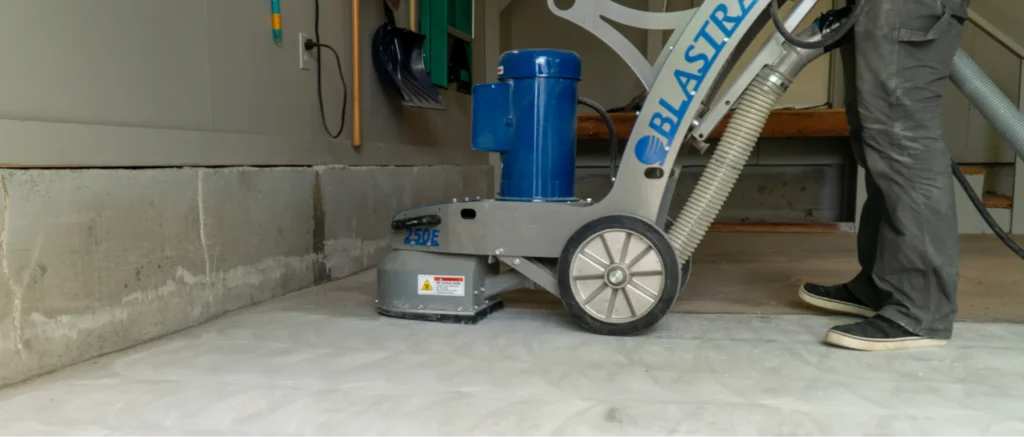
For an epoxy or polyaspartic coating to bond to concrete, the surface has to be rough. Microscopically rough. The flooring industry measures this on a 1-to-10 scale called the Concrete Surface Profile, set by the International Concrete Repair Institute (ICRI Guideline 310.2R-2013).
A real coating needs CSP-3 to CSP-5. Acid etching (what’s in every DIY kit and what cheap installers still use) only gets you to CSP-1 or CSP-2.
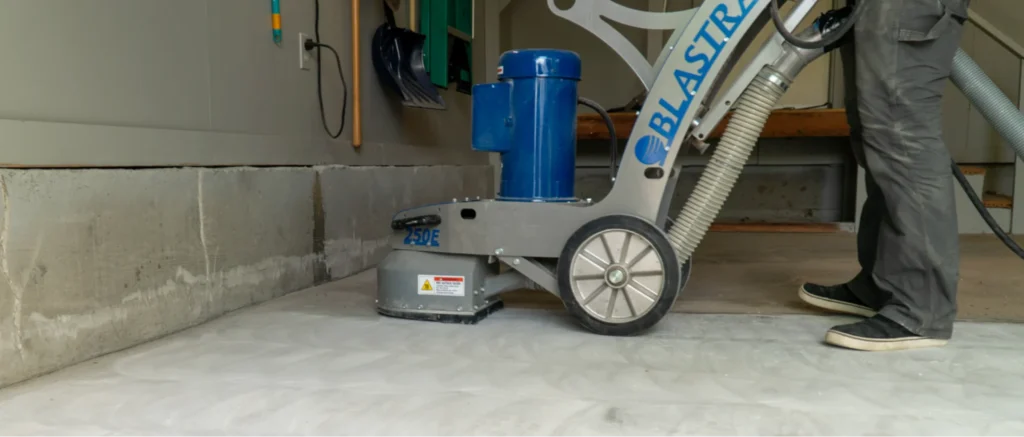
Ask for the answer in plain words. If they say “we acid wash” or “we just clean it really well,” walk away. If they say “we run a 175-pound diamond grinder over every inch of the slab to CSP-3,” you’re in the right place.
Question 3: “Will You Run a Moisture Test Before You Quote My Final Price?”
This question stops the most common Kansas City coating scam: the day-of moisture upcharge.
Here’s how it works. A salesperson quotes you $4,000 for a 2-car garage. You sign. The crew shows up, grinds the slab, then suddenly “discovers” your concrete has moisture issues. The price jumps $800 to $1,500 for a moisture barrier. You can’t really say no — your garage is half-prepped and full of dust.
A real contractor tests before they quote. The two formal industry-standard tests are:
- ASTM F1869 (calcium chloride) — measures how much water vapor leaves the slab in 24 hours.
- ASTM F2170 (relative humidity probe) — measures moisture inside the slab itself.
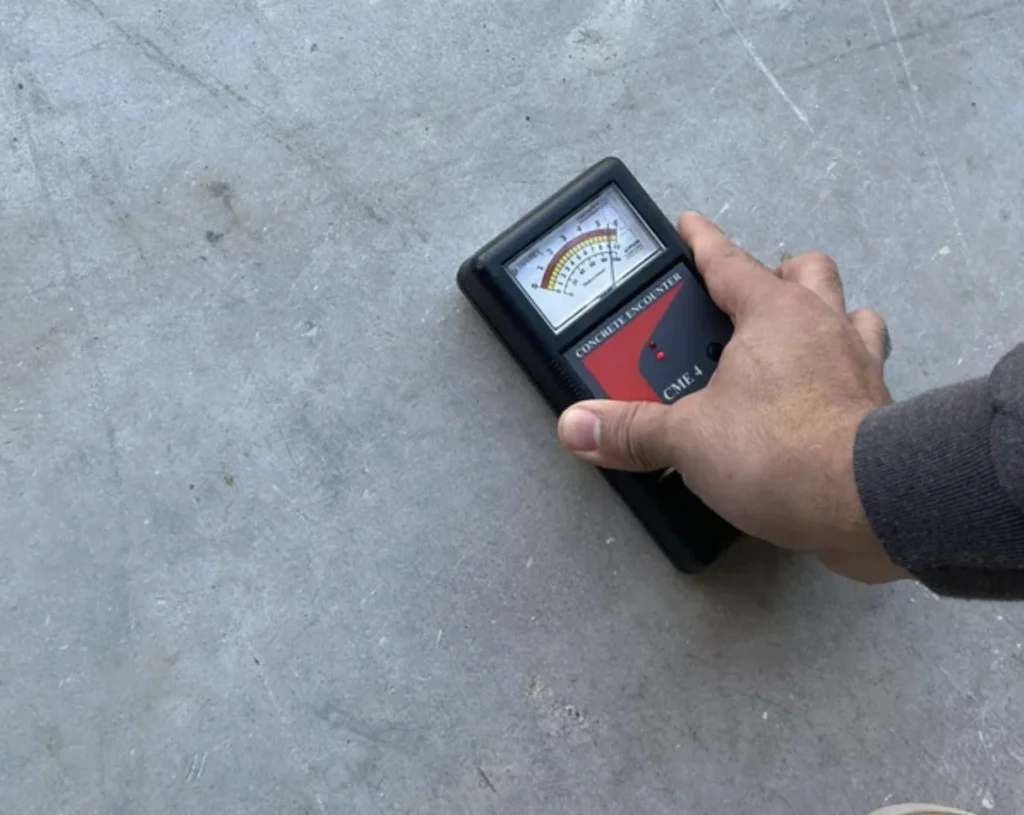
A residential garage doesn’t always need a formal ASTM test, but it does need a contractor who actually checks your slab before quoting — not someone who waits until the grinder is running. Ask flat out: “What could change the price on install day?” If moisture is on that list, walk away.
At Garage Flex, we check moisture at every in-home assessment so we can read your slab. If we find elevated moisture, we identify it.
Question 4: “Who Makes Your Coating, and Are You a Certified Installer?”
This separates the brand-name pros from the bucket-grade operators.
Real concrete coatings come from manufacturers like Penntek, Sherwin-Williams, Sika, or PPG. Many of these brands sell only through professional distribution channels and run training programs for the contractors who use them.
Get the brand name from your contractor and take 30 seconds to Google it. You’re looking for an actual concrete coating manufacturer with a network of professional installers — and a product that isn’t sold at Home Depot or Lowe’s. Consumer-grade kits and pro-grade coatings are completely different products. If the product your contractor names is on a big-box shelf, it’s basically the same chemistry as a $300 DIY kit.
Bonus: ask to see the manufacturer’s technical data sheet (a 1-to-2 page spec sheet listing solids percentage, dry film thickness, and chemical specs). You don’t need to read all of it — the fact that the contractor can actually produce one separates real pros from operators winging it.
Question 5: “Show Me the Warranty”
“Lifetime warranty!” sounds amazing on a yard sign. But warranties are exclusion documents — what they don’t cover matters more than what they do. Read the actual document, line by line, before you sign anything.
Three things to look for:
- The moisture clause. Almost every coating warranty in the industry excludes moisture-related failures. That’s actually fair — moisture is something the slab does, not something the contractor controls. The real question is: did the contractor test for moisture before installing, and did they tell you what mitigation costs in writing? A coating company that runs a moisture test, walks you through the numbers, and offers a moisture-mitigating primer up front is doing it right. A company that hides the clause and never tested is using it as a get-out-of-jail-free card.
- The labor clause. Some “lifetime materials warranty” deals stick you with the labor bill on a re-do — which is 60% to 70% of the actual cost. Ask flat out: “If the coating fails under warranty, do I pay anything to have it fixed?”
- The lifetime claim. A “lifetime warranty” is only as good as the company backing it. Ask how long the local owner has been in business in KC, not the parent franchise. And read the fine print — “lifetime” coverage often requires a specific upgrade tier (like a moisture vapor barrier primer or an extra polyaspartic top coat). Make sure you understand what gets you to lifetime, and whether the warranty is transferable if you sell the house.
The industry standard for a quality polyaspartic install is a 15-year written warranty against peeling, chipping, delamination, and UV discoloration. Anything that sounds bigger than that without specific terms in writing is marketing, not protection.
Question 6: “Who’s Actually Doing the Work — and How Long Have They Been Installing Coatings?”
Watch out for the experience trick. Contractors love to advertise the franchise network’s 20 years, or the manufacturer’s 30 years, or “decades of experience” without saying whose decades. The real question isn’t how long the LLC has been registered — it’s how long the people on your slab have been pouring polyaspartic.
A brand-new company run by a 20-year flooring veteran is a totally different proposition from a 5-year company run by a guy who watched YouTube videos. So dig in:
- “Who started the company, and what were they doing before?” Real coating pros usually came from concrete, flooring, or industrial coatings backgrounds.
- “Who will physically be on my slab — your in-house crew or subcontractors?” Subs aren’t always bad, but you should know who you’re actually hiring.
- “Can I see photos of your recent installs in JoCo or KCMO, with neighborhoods named?” Real installers will send them. Stock photos are a giveaway.
Then ask for two or three references. Even a young company should have a handful of homeowners willing to vouch — and a homeowner reference in your suburb is worth more than any marketing claim.
Question 7: “What’s the Final Price in Writing — and What Could Change It on Installation Day?”
Get the number on paper. Get the things that could change the number on paper too.
Real surprises do exist. A massive oil stain or a large cement crack might genuinely cost extra. But those should be flagged at the quote, not invented on install day.
Ask:
- “What’s included in this price? What’s not?”
- “What conditions could trigger a change order?”
- “Will you call me before charging extra, or just bill it?”
A real contractor gives you a single, all-in number. A bad one gives you a base price and then “discovers” $1,200 in upgrades after the grinder fires up.
Frequently Asked Questions
A polyaspartic install on a 2-car garage in the KC metro typically runs $2,500 to $6,000, depending on slab condition, square footage, and finish choice. Anything dramatically below that is using cheaper product or skipping prep.
Yes, but read them carefully. Look for recurring themes (timeliness, communication, prep quality), photo evidence, and how the company responds to negative reviews. Look at reviews across Google, Houzz, and BBB — not just one platform.
A manufacturer warranty covers product defects. An installer warranty covers workmanship. Most garage floor coating failures come from workmanship issues like bad prep — not product defects. So the installer warranty is the one that matters most.
A properly installed polyaspartic system in the KC metro should last 15 to 20 years with normal use. The KC freeze-thaw cycle and road salt are tough on coatings, but polyaspartic resists both better than epoxy.
Not automatically — some local franchisees run great installs. But always ask for the local owner’s start date and install count, not the parent company’s history. A new franchisee with 6 months of experience often markets the same as a 20-year vet.